
On World-Building apps
The best tools for building worlds.


For me, the best part about crafting a story in any medium is building out the world. This doesn't necessarily happen before the writing process starts, but a decent chunk of it often does, and then it continues throughout the writing, so the world evolves as the story uncovers new bits of it.
To me, the best, and certainly the most beautiful, book on world-building is Jeff Vandemeer's "Wonderbook". This is a pretty comprehensive walkthrough of how to build worlds and it's a great book to dip into at any point for inspiration. In addition, I have seen it on enough executive's bookshelves in Hollywood to suggest it's worth being across if you're in that world.
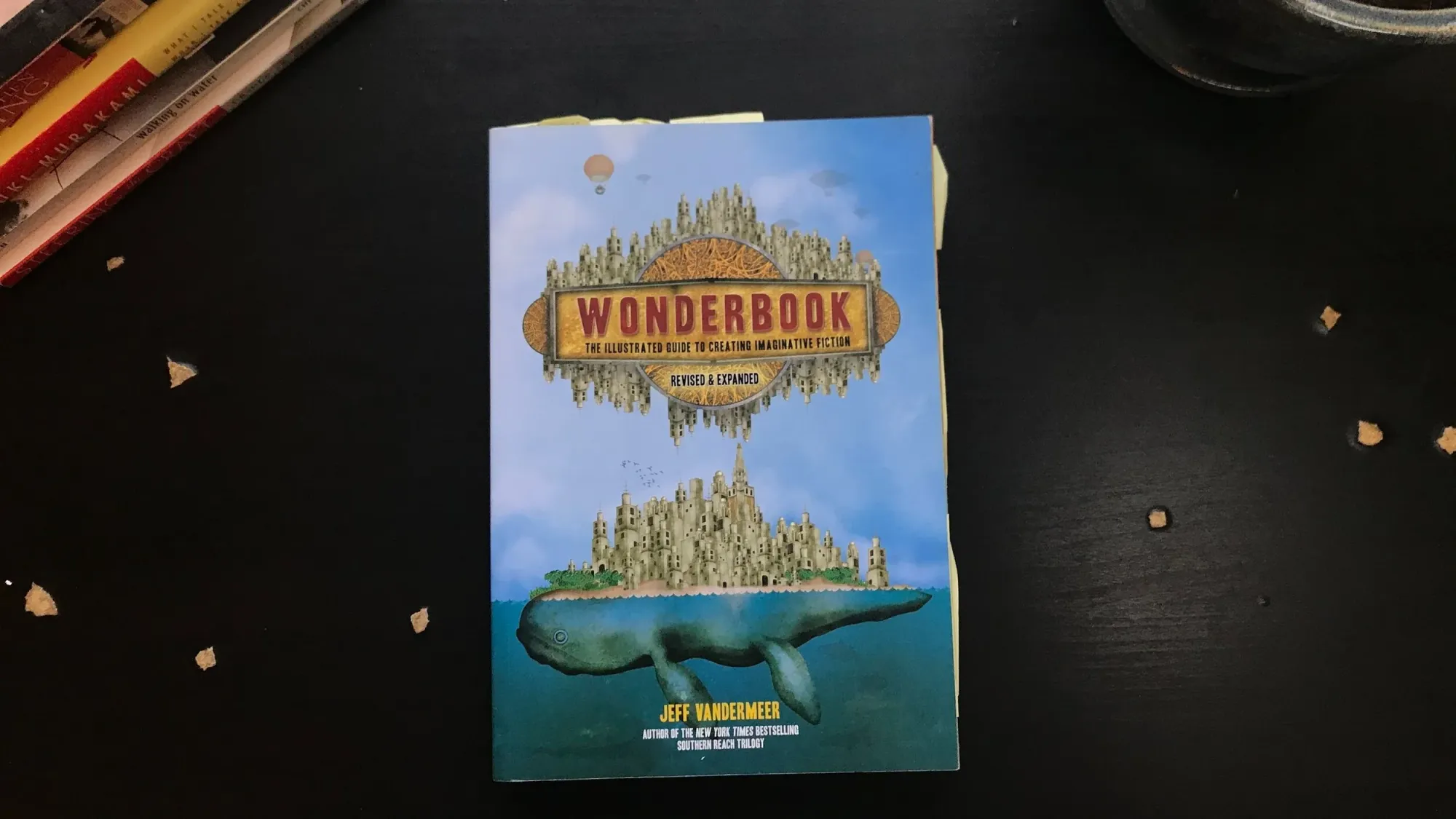
As Vandemeer demonstrates, the subject of world-building is worthy of a gigantic book, so I'm not going to cover very much of it here. My main focus is the apps I use to make the process a little easier and more ordered, but by way on introduction, let's at least get an overview.
Firstly, world-building is a concept that suggests science-fiction and fantasy but is absolutely not confined to that. The moment you dream up a character and put them in a situation, you are building a world. "Happy Valley" is a world, "Breaking Bad" is a world, "The Wire" is a world. Characters interact in an environment to which rules are applied; sociological rules, psychological rules. Yes, you might also be playing with the laws of physics and biology, but you don't have to be to build a world. "The Wire" seems realistic in its portrayal of Baltimore precisely because the world-building is based on a lot of research and experience. But at the point that you decide "Stringer would do this" or "Stringer would not do that", you are world building.
So where do you start? You start with the basics - what genre are you in? Genres all have a loose set of rules that we are intrinsically aware of without needing to read a book about it; the rules of horror are distinct from the rules of a gritty crime piece or the rules of space opera.
One of the things I love about world-building as an exercise, is that you don't always have to start with a story. You don't yet need to know that this is a piece about a character who wants X but is stopped from getting it by Y. That's nice if you have it, but you can grow the seeds of a world from an image, a character, a "What if...?" notion; from anything at all. It's play, essentially, an act of imagination. Of course, you're hoping that a story is going to emerge, and it will if you give the process enough time and intent, but you don't have to know what that story will be when you start.
What you do have to be prepared for, though, is that the story is going to severely prune your world-building at some point. Even if you have built the entire Star Trek universe from scratch, the second you land on your story it will become apparent that you cannot possibly show off the whole universe in one go. World-building is like research in that way - you want to do a lot of it, but you're never going to be able to use it all.
But a world that is big enough, or that can expand as you go, makes for multiple story opportunities. The Pleasant Green Universe, for example, has grown with the Lovecraft Investigations and expanded beyond them, to encompass the Mythos series and several standalone stories and online serials. And it keeps growing and interlinking and throwing up more and more ideas. Pleasant Green was not built this way, or at least not consciously. It evolved as more stories found themselves set within it.
So you start with a genre and then you want to be thinking in terms of mood and images and ideas for people and events. And none of these things need to link together yet, but they will need to, and you will need to start keeping track of them. Because the connections you make will breed more connections and things will start to surprise you. But you need to maintain some kind of overview. And that's where the apps come in...
It's worth saying from the top that your best and most useful tool is a paper notebook. Long before the invention of the computer, Dickens, Tolkein, Tolstoy etc were building intricate complex worlds with pen and paper. It can still be done that way and, because of the way writing with pen and paper activates the brain, it is still one of the best methods to spark ideas and make connections. Start with pen and paper. Always.
OK, so let's do apps... For my money, Obsidian is better than anything else in the field. Your mileage may vary, and you should use whatever you already know, or are most comfortable with. But Obsidian for me is quick and easy, it allows for the creation of links between notes, and then provides a map of the network you are creating so you can easily see what relates to what and what might be missing.
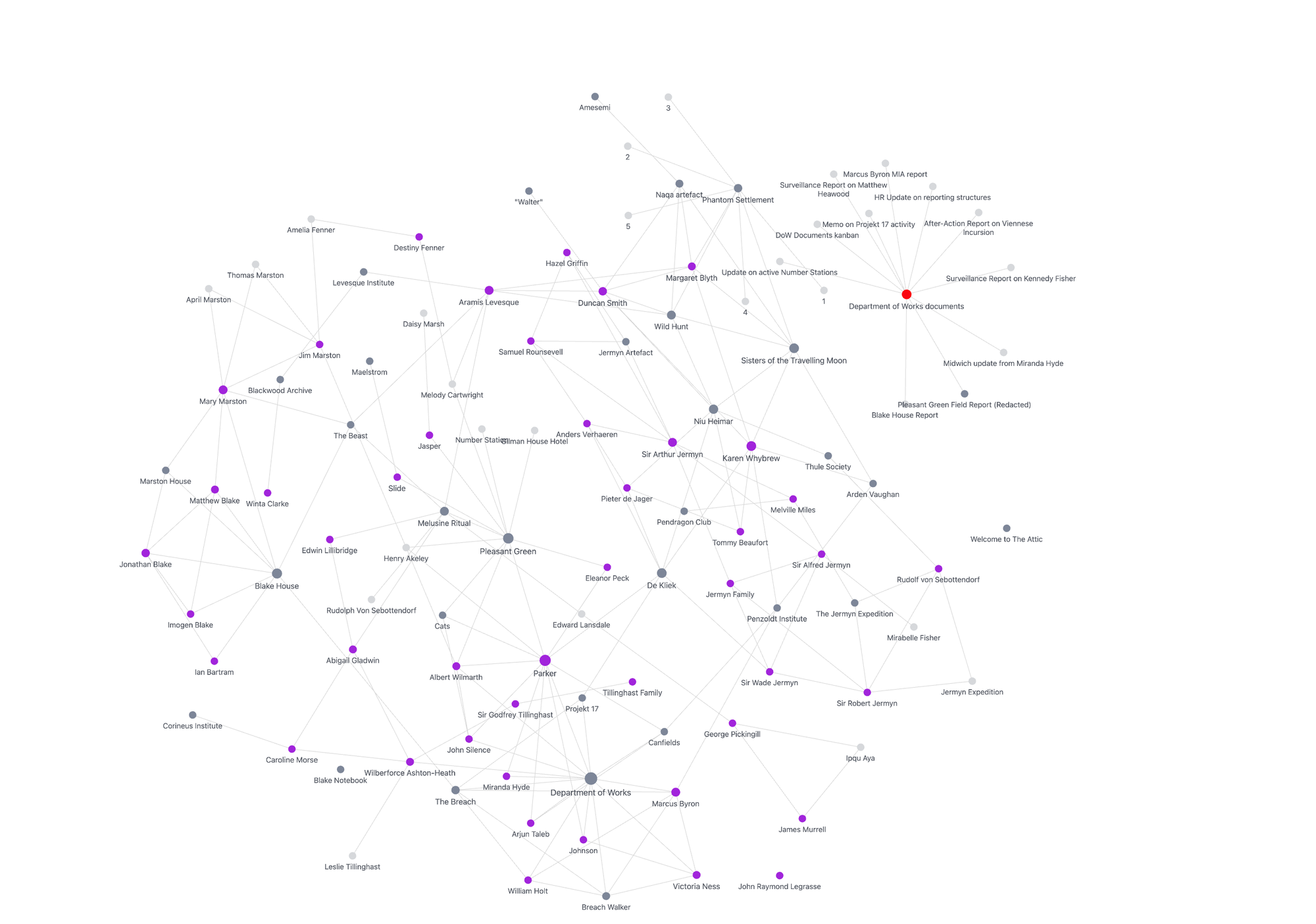
One of the unsung heroes at the early stages of world-building is speed. If you have to spend too much time formatting or tagging or digging out templates, then you quickly lose the spontaneity of creation.
Starting from scratch, I would create the following folders, headings or tags:
- People
- Places
- Things
- Ideas
Call them what you want, but those are the main categories you need to work with. You have an idea for a character? A couple of lines, or as much as you know, and in they go to the "people" folder. If that character has a sibling or a parent or a child or a best friend or a lover or a nemesis, throw them in to and make a link between the two. Perhaps you know where they were born (a place) or a where they live now. Or you know they have a particular object or a piece of jewellery (a thing), or maybe they are the murder victim and that thing is the piece of evidence that's going to allow someone to solve the murder... Well where was that found (place) and who found it (person) and how did they link it to the victim (idea). Pretty much anything you think of at this stage can go into one of these four categories, and the more links you make between items, the more links and new items will occur to you.
At this stage, I am resolutely NOT thinking about story. Let your world grow and then see what you can make with it. Sure, you're bound to have a few building blocks. But if you start thinking along the line of "This person can't be related to that person because I need them to do X later", then you're putting the cart before the horse. Let your world grow organically. If your hero's nemesis turns out to be her sister, maybe that's a feature, not a bug?
Visual reference and inspiration is always handy. Obsidian can handle this in its "Canvas" feature, essentially an infinite digital whiteboard. But if you want something prettier, try out Milanote - this is an Australian app aimed at designers, so it does a great job of letting you create a digital "murder-board" of images, text and links. I could easily make an argument for doing the whole job in Milanote BUT, as of time of writing, it does not work offline and the mobile experience is useful, but not great.
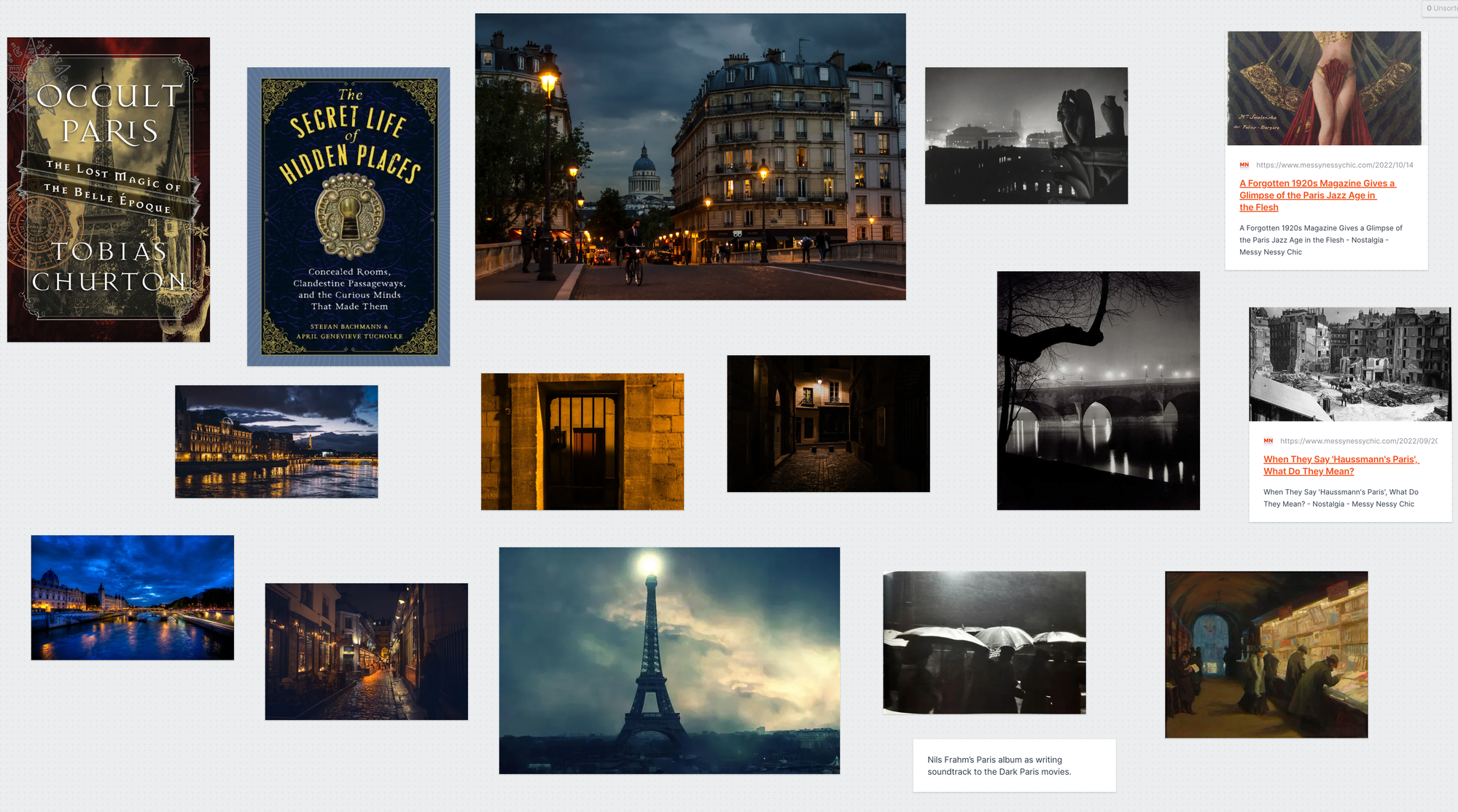
(As a "live" side-note, just sourcing that Milanote screenshot made me want to jump back into that project, and a bunch of ideas leaped to mind just glancing at those images - that is exactly how this methodology is supposed to work.)
If your genre is historical, or fact based, or just involves a lot of dates, then Aeon Timeline is your friend. I've written about it fairly extensively HERE, but I rely on it constantly for any work I'm doing in the Pleasant Green Universe. In a nutshell, Aeon Timeline lets you enter any event in your story, give it a date, and then it builds a visual timeline that shows the sequence of events. The app does an awful lot more than that, but this is its essence. If you know when one of your characters was born, you can enter their birthday and see how old they are at any point in your story. As a timeline builds, serendipity (always your best friend) starts to kick in and you will find events colliding and crossing over in infinitely suggestive ways.
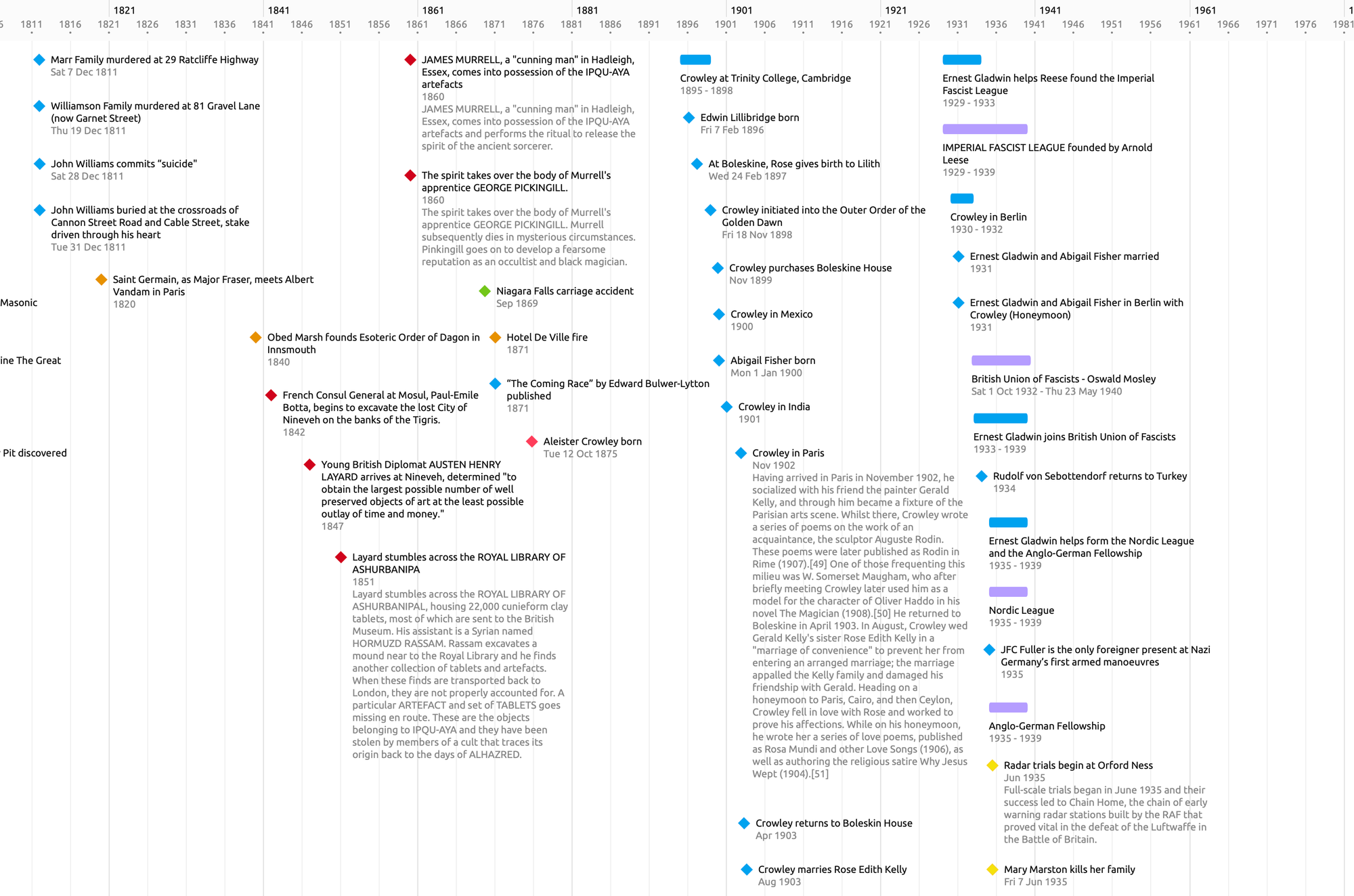
At all stages of the world-building process, and well into the writing process, the more different angles you can view your world from, the better; Obsidian maps, Milanote layouts, event timelines; all of these are useful. And then there's Mac Family Tree. This is, in many ways, an absolute dog of an app. It's needlessly difficult to use, and I'm sure there must be better alternatives out there, but this happens to be the thing I used to build out four centuries' worth of familial relations for Pleasant Green, and so I'm stuck with it.
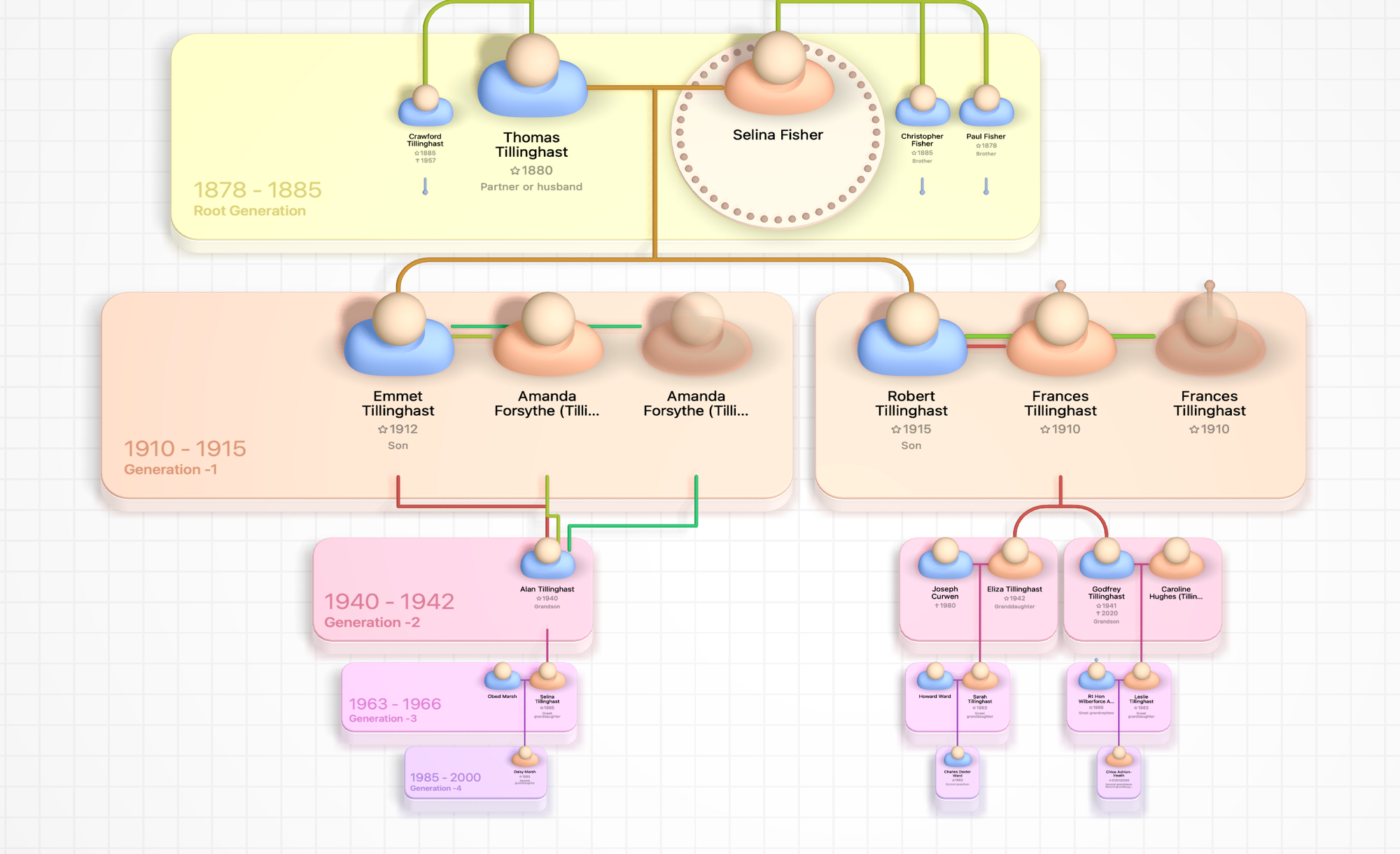
A family tree, even if you just draw it out on a sheet of paper or plot it in Milanote can be invaluable if it is relevant to your world. As with all the other views, the aim here is to put in enough information that you start to see both gaps and connections. A family tree shows you relative generations, and suggests where people might know each other. It shows you instantly that you have given this character a mother, but no father and so who might that be and where did he come from? These gaps build out the world and make it more solid. And for those still grasping for a story to tell, the gaps and connections start to suggest ideas.
But, to circle back, all you ever REALLY need is a pen and paper. The tech makes it easier, but I don't think the tech is the place to start.
And as to where it ends... Your world should give you a story, and then the world should continue to grow as new people, places and things announce themselves in the narrative. When the story is done, the world need not collapse or disappear. It can continue to grow and, if you let it, it might flower and bear fruit over and over again.