
On a LifeOS
Figuring out what's important and what to do about it.


Here is wisdom. Well, maybe not wisdom exactly. But something...
And it's a change of pace from the usual Pro letter, even though I think it's definitely still within the ballpark.
I tend to eye-roll phrases like "second brain" and "lifehack" pretty hard. I had the same reaction when "LifeOS" started to be bandied around - keeping a notebook or having a todo list is not a "Life OS", calm yourself.
In truth, I don't even know what LifeOS is supposed to mean, and I'm not sure the people typing it know either. I guess it gets you a decent amount of clicks on Medium, and that's good enough for some.
But then I started noodling around with a few ideas for how to organise myself better, how to address what had become an endless drudge of tasks and projects that consumed the day but didn't seem to offer much in the way of fulfilment, and I realised that what I was building was something akin to a LifeOS. So now I'm using the phrase, and I have become one of THOSE people. Apologies.
Yes, paragraph six is around the point where people are going "What the hell is he on about?" OK, so what I'm talking about here is a work-in-progress methodology to map out and organise the future, life-planning if you will, that seems to be coherent, workable, and illuminating. The reason I think it might be helpful to Pro subscribers is that we all have things we would like to achieve that we can't seem to find time for, or that seem too nebulous to plan properly, and we all find ourselves doing things that seem to be required but which we resent in some way. That's just how life works. Or is it?
My contention is that we're all mostly moving through life, tackling the next thing as it comes. We're like someone riding a bike on a pot-holed road; we're watching the ground a few feet in front of us, navigating hazards, and we rarely look up to see where we're actually heading. I'm as guilty of that as the next person, and so I'm trying to address it because I have realised of late that dodging potholes is all I've been doing for a while, to the extent that I am in danger of losing sight not only of the destination, but why I even got on the bike in the first place. I can't be alone in that.
I wake up in the morning, make a coffee and look at my todo list. Generally speaking, it is more than a day's worth of stuff and it is a mix of household admin, e-mails to be returned, the odd zoom meeting, and some projects to work on. None of it looks very appealing. Broken down into "manageable" chunks, even the projects I wanted to do have now become a series of potholes. And so I start bargaining with myself: if I do these three things, then I could have another cup of coffee; write these pages and I can go for a walk; do this that and the other and I have earned watching an episode of something over lunch. It works fine, as in I am moving forward and ticking things off. I'm "productive". And it's not like I'm working down a mine; I'm at home and I get to write for a living and really, what is there to complain about? It's just that, when I take a step back, it's not really the way I wanted my days to play out. And I can tell myself that, once X,Y and Z has happened, I can relax, or travel, or enjoy the spoils. But what are those spoils and when do they come? And haven't I been living this day over and over again for decades now, expecting that at some point it will change?
Anyone who has been reading these missives for any length of time will know that I have tried every productivity and note-taking app that has ever been invented, to varying degrees of satisfaction. What I have never really tackled, though, is an underlying system. Everything has been designed to organise the grind. Nothing has questioned the grind.
And so here I am on a sunny Autumn Saturday morning, doing some long, LONG overdue work on a system. On a Life OS, if you will. And so I figured I'd tell you about it, in case it's useful.
Here's the theory, and I apologise in advance for torturing the already weak cycling analogy: tasks are the potholes. These are the incremental things that we might list or not, but that take up so much of our days; admin, errands, appointments, work tasks. They're not all terrible, neither are they necessarily avoidable. But we navigate them every day; they are the waypoints and we move through one to another until we run out of time.
But tasks are actually parts of a larger whole, and it's incredibly easy to either lose sight of that, or even to not realise that they might together constitute part of something that we don't even want - they could be sending us in the wrong direction without us even being aware of it.
If tasks are the smallest piece, then the biggest piece is our values. I'm going to capitalise that: VALUES! These are the big, hard-to-quantify things that actually mean everything. Things like health, happiness, family life, social interaction - things that we sort of take for granted, sort of crave, but mostly don't pay too much mind to because they are a little hard to grasp and we know we think they're a big deal but we don't really know what to do about them. And anyway, we have to empty the dishwasher now.
But VALUES are the thing we really need to stop and define, because we're going to build a system here, and that system works top down: VALUES > GOALS > OBJECTIVES > PROJECTS > TASKS.
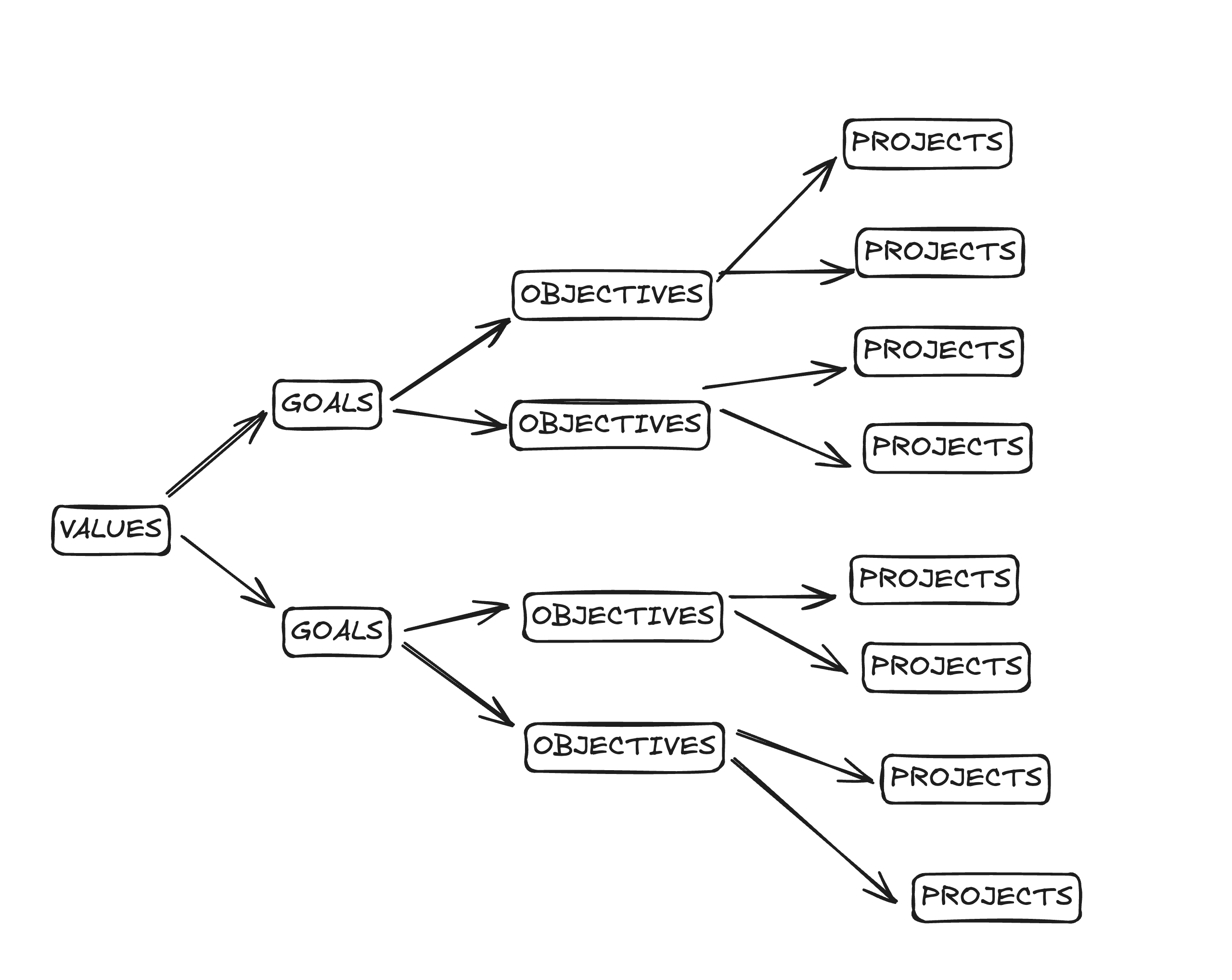
This is a deceptively simple system, but its foundation is values, so it's worth taking a moment, or an hour, or a weekend, to sit down and really figure out what yours are. I found it helpful to write "What is important?" on a piece of paper and make a list. Values are not something that has a deadline, or is easily achieved. A value is not something that can ever, in fact, be achieved, it will never be ticked off a list and marked "done". It is an ongoing state of being, definitive in the very sense that it defines you. You want emotional stability, or financial security, or a good professional reputation, or a rich social life. You might want all or none of the above. But the things you inherently consider to be the building blocks of your life, those are your values.
So let's run with an example and take a value that most of us will have: physical health. We value that, right? Whatever situation we're in at the moment, whatever the current starting point, we would all like to either improve or maintain physical health. You may have others; creativity, security, learning... There's no limit to what you can write on that piece of paper, we're after the core values that define who we are and who we want to be.
So make a list of your values, and where two or more look like they might be basically the same thing, rephrase and condense. You don't want thirty of the things, you want a decent handful. Health, security etc.
The list can, in itself, be a valuable mental reset. But to take it further, we need to work those values into our lives. A value is pretty useless unless you are acting upon it, working towards it or exercising it in some way. And so each value needs to have a GOAL attached to it, and it can have as many goals as you like.
Taking our physical health as an example value, we might now attach some goals like "Lose weight" or "Eat better" or "Exercise more". Depending on our starting point, our goal might involve recovery from an injury or illness. These are goals, not objectives. The difference between these seemingly interchangeable things will become apparent, but for now a goal is bigger than an objective - it is something that takes place over time. It's the destination, not the journey. It's "I'd like to go to Malaysia" before you start looking at plane tickets and hotels. It's an idea that is objectively achievable over a long-ish time fram, even if you don't know how to do it yet.
So for our physical health value we might want to improve fitness. How might we measure that improvement? A goal may be big and long term, but it needs to be measurable. So perhaps we might decide that running a marathon would be a goal that would clearly mark a big improvement in physical fitness. (A side note here - when you have run the marathon, the goal has been achieved, but the value remains. If a value doesn't have a goal attached to it, then it is lying dormant. Once you have run the marathon, you need to attach a new goal to the value.)
Running a marathon is a good goal. It's actionable, insofar as we'll be able to tell when it's happening, but it's still pretty general. We're going to need to put a time frame on this one, because without a goal without a deadline is just a notion. Let's say we want to run a full marathon in a year's time. That's a goal.
But we know that, in order to be someone who runs 26 miles a year from now, we probably need to get off the sofa before that. So now we need some OBJECTIVES that fit into the bucket of that goal.
Where a goal is big and long-term (running a marathon), an objective is smaller and the time-frame is shorter. So some objectives now might be to lose some weight (this would be a specific, realistic amount of weight in a short time frame, otherwise a more general "Lose Weight" would be a goal), to get to the point where running 10K doesn't kill you etc etc. I don't run, so for me, the first objective might be to get to the point where I can run a meaningful distance without keeling over. And that might involve a number of factors; alongside some stamina training, I would need to change my diet, I might need to do some strength training etc.
To make use of another example, you might have a value that is to do with living a creative life and you might have a goal within that to become a published novelist. The first step on that path would be to write a novel, or perhaps to start with some short fiction. Either of those would be objectives - "I'm going to write 3 short stories in the next six months", for instance.
So a Goal is big and long term and an Objective is a smaller step towards that, in a shorter time frame. I'm sure you're following along fine.
Objectives are now broken down into PROJECTS. In our marathon example, we might have an objective to build up our running stamina, so we might have a project to do a Couch-to-5K programme. We all know what projects are, but just on the off chance, this is a contained effort in a finite amount of time. It's a smaller unit than an objective. Getting to 5K might only take a month, whereas writing a novel could take a year or more. But both are projects because they are finite, have a clear endpoint, and can be bundled together and contained within a larger Objective, which in turn is contained within a Goal. It's a Russian doll structure.
The smallest doll is the task. We all know what a task is. We break our project down into tasks and so we run every day until we have got to 5K or we write a certain amount of words, or we write for a certain number of hours each day until we finish the short story or the novel. That's basic stuff.
BUT here is where the LifeOS stops being basic (or at least where its power lies)... NOW you are not putting your running shoes on just because; you're putting them on because running every day leads to running 5K which leads to 10K, which leads to a marathon, which is a life goal and which contributes to your valuing physical health. The motivation is built into the system (except when it's cold or rainy, obviously).
Where the system becomes really interesting is where we identify values that don't have goals attached. Why is there no goal attached to this value? This is a thing that is important to you that you are doing nothing about. Likewise, you might have a goal but no objectives springing from it; fix that - this goal is something you want to do, why are you not running the structure to ultimately drop related tasks into your daily life? What are you waiting for?
We spend so much time mindlessly grinding through things without stopping to question if this is the road we want to be on. And we have all these things that we'd like to get to ONE DAY, but first we have to dive into this never ending pile of STUFF. This methodology at least allows you to check the map and make sure you're still heading in the right direction. Not only that, but it presents you with opportunities for new endeavours which, because they link to your core values, become EVERY BIT as important and justifiable as whatever you have to do to earn money.
And the idea is that the hierarchy runs both ways: a value is useless without a goal attached to it, just as a task is redundant unless it contributes upwards.
A useful, if obvious, point to make is that ALL projects get broken down into tasks (otherwise they are themselves just tasks) BUT not all tasks needs a project. Emptying the dishwasher is not part of a project BUT it does link upwards to either a VALUE about living in a nice place or taking care of the household or similar OR it might link to a GOAL or OBJECTIVE to do with being a more attentive spouse or doing your fair share of the housework or whatever. The point is that a task that does not in any way link upwards should not be on your list in the first place.
That last point might take a moment, because if you work in an office, there are sure as hell things that you are being asked to do that, on the face of it, have nothing whatsoever to do with your values or goals. Except they do. Because if you value financial security, for example, then keeping your job and maintaining relations with your boss or co-workers is a goal. And so fiddling with that spreadsheet suddenly has some kind of a purpose. You're not doing it for them, you're doing it for you, and that reframes the picture somewhat.
And I think reframing is what this is really about. Currently (because I am not done structuring this system for myself at the moment), I have a bucket of tasks labelled "Admin". That is not a bucket I relish dipping in to, because "Admin" as a context seems dreary. But if we look at what is in it, we have some stuff to do with my daughter's university finances and a bunch of emails that need to be responded to. Taken as a lump, it seems dull and it will take me ages to face it. But if instead of labelling these tasks as "Admin", I look at each one and see how dealing with university finance aligns with my value of taking care of my family, or that the email back to the studio exec actually advances the progress of my objective to get a TV show off the ground (even indirectly), then these things gain a worthwhile purpose and the motivation to do them increases.
And I'm not just suggesting reframing these things psychologically; I'm saying do it for real. Whether you use task management software, a bullet journal or just a pad and pen, structure your tasks via Values, Goals, Objectives and Projects (Can we call it the VGOP Method? Is there a book in this?!) so that when a task is presented to you in the morning, you can see where it comes from and what it links up to and WHY you are doing it.
And likewise, if the task DOESN'T ultimately align with one of the core values you have identified for yourself, cross it off the list. As Tyler Durden tells us, "This is your life, and it's ending one minute at a time."
I'm going to spend the rest of the weekend building this system out. If anyone fancies giving it a go, I'd love to hear how it works out.